
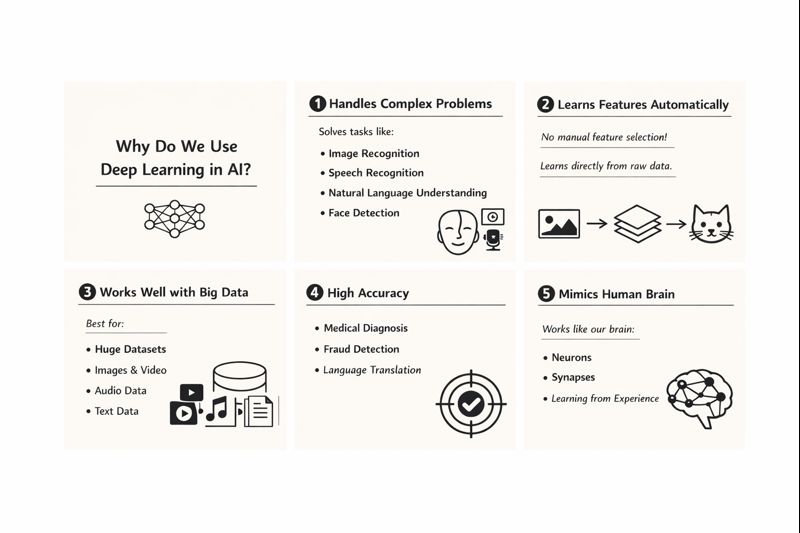
Artificial Intelligence (AI) has undergone a remarkable evolution over the past few decades. From rule-based systems that could perform simple logical operations to sophisticated algorithms that can understand images, language, and even emotions, AI has transformed the way we interact with technology. One of the most significant breakthroughs in this evolution is deep learning, a subset of machine learning that has enabled machines to perform tasks that were once considered exclusive to human intelligence. But why do we use deep learning in AI, and what makes it so powerful? Let’s explore this in depth.
Understanding Deep Learning
At its core, deep learning refers to a class of machine learning algorithms inspired by the human brain’s structure and function. These algorithms use artificial neural networks composed of multiple layers—hence the term “deep”—to process and learn from large amounts of data. Unlike traditional machine learning algorithms that require feature engineering and manual input, deep learning algorithms can automatically extract features from raw data, making them highly adaptable for complex tasks.
A typical deep learning model consists of three primary components:
- Input Layer: Receives raw data such as images, text, or audio.
- Hidden Layers: These layers perform complex computations and learn intricate patterns in the data.
- Output Layer: Produces the final result, whether it’s a classification, prediction, or recommendation.
The depth and complexity of these layers allow deep learning models to capture subtle patterns in large datasets that traditional algorithms often miss.
Handling Large and Complex Data
One of the main reasons deep learning is widely used in AI is its ability to handle massive and complex datasets. In today’s world, data is generated at an unprecedented rate—from social media posts and online transactions to medical records and sensor data in IoT devices. Traditional AI methods struggle to process and analyze such enormous volumes efficiently.
Deep learning, however, thrives on big data. Its neural networks can learn hierarchical representations, meaning that lower layers detect simple patterns (like edges in images), while higher layers identify more complex concepts (like faces or objects). This ability to automatically extract relevant features without human intervention is a critical advantage.
Superior Accuracy and Performance
Deep learning models often outperform traditional AI models in terms of accuracy and performance, especially in tasks involving perception and recognition. For example:
- Image Recognition: Convolutional Neural Networks (CNNs) have revolutionized computer vision, enabling machines to accurately identify objects, faces, and even emotions in images.
- Natural Language Processing (NLP): Recurrent Neural Networks (RNNs) and Transformers allow AI to understand, generate, and translate human language with high accuracy.
- Speech Recognition: Deep learning models can transcribe spoken words into text more reliably than earlier speech recognition systems.
The high accuracy of deep learning models is particularly valuable in industries where precision is crucial, such as healthcare, finance, and autonomous driving.
Learning from Unstructured Data
Another compelling reason to use deep learning is its ability to work with unstructured data. Unlike structured data (e.g., spreadsheets or databases), unstructured data comes in forms like images, audio, video, and text, which are inherently messy and challenging to analyze. Deep learning models can process this data directly, detecting patterns and insights that were previously inaccessible.
For instance, in the healthcare sector, deep learning can analyze medical images like X-rays and MRIs to detect diseases early. In social media analytics, it can interpret sentiment from posts, images, and videos to understand public opinion. Traditional AI techniques often require extensive preprocessing and manual feature extraction to handle such data, making deep learning the superior choice.
Reducing Human Intervention
Deep learning reduces the need for manual feature engineering, a process where human experts define which features of the data are relevant for the task. In traditional machine learning, this step is critical but time-consuming and prone to human bias. Deep learning models automatically learn the optimal features from the raw data, which not only speeds up development but also increases model accuracy.
For example, in self-driving cars, deep learning models automatically identify lanes, traffic signals, pedestrians, and obstacles without requiring engineers to explicitly define rules for every scenario. This autonomy is crucial in dynamic environments where human-defined rules may fail.
Enabling Real-Time Predictions
In AI applications, real-time decision-making is often essential. Deep learning models, once trained, can process large amounts of data quickly and make predictions in real-time. This capability is vital in fields like autonomous vehicles, fraud detection, and personalized recommendations.
For instance, streaming services like Netflix and YouTube use deep learning algorithms to analyze user behavior and provide personalized recommendations instantaneously. Similarly, financial institutions rely on deep learning to detect fraudulent transactions as they occur, preventing significant losses.
Scalability and Flexibility
Deep learning models are highly scalable and flexible, which makes them suitable for various AI applications. These models can be scaled to accommodate increasing data volumes and computational power, ensuring they remain effective as data grows. Additionally, deep learning can be applied across different domains—vision, language, robotics, and healthcare—without fundamentally altering the underlying architecture.
This flexibility allows organizations to leverage the same deep learning techniques across multiple AI applications, reducing development costs and accelerating innovation.
Continuous Improvement with More Data
Another key advantage of deep learning is that model performance improves as more data becomes available. Unlike some traditional AI algorithms that plateau after a certain dataset size, deep learning thrives on large datasets. This property aligns perfectly with the modern era of big data, where continuous data streams are generated daily.
For example, voice assistants like Siri or Alexa continually improve their speech recognition capabilities as they process more voice commands. Similarly, recommendation systems get better at suggesting content as they analyze more user interactions.
Solving Previously Impossible Problems
Deep learning has enabled AI to tackle problems that were once considered unsolvable. Tasks like image captioning, autonomous navigation, machine translation, and advanced game playing (e.g., AlphaGo defeating human champions) became feasible only because of the ability of deep learning to model complex patterns and relationships in data.
In medical research, deep learning helps in drug discovery by predicting molecular interactions and simulating chemical reactions, significantly reducing the time and cost of development. These breakthroughs demonstrate how deep learning expands the boundaries of what AI can achieve.
Challenges and Considerations
While deep learning offers numerous benefits, it is not without challenges. Some of the key considerations include:
- Data Requirements: Deep learning models require large amounts of labeled data for training, which can be difficult or expensive to obtain.
- Computational Resources: Training deep neural networks is computationally intensive and often requires specialized hardware like GPUs or TPUs.
- Interpretability: Deep learning models are often considered “black boxes” because understanding their internal decision-making process is challenging.
- Overfitting: Without proper regularization, deep learning models may memorize training data rather than generalize well to new data.
Despite these challenges, ongoing research in AI and deep learning continues to address these limitations through techniques like transfer learning, model pruning, and explainable AI.
Conclusion
The use of deep learning in AI is driven by its unparalleled ability to learn from complex, high-dimensional data, achieve superior performance, reduce human intervention, and scale across diverse applications. It enables machines to perceive, reason, and act in ways that mimic human intelligence, opening doors to innovations across industries—from healthcare and finance to entertainment and autonomous systems.
As AI continues to advance, deep learning remains a cornerstone technology, transforming not only the capabilities of machines but also the very fabric of our digital world. Its adaptability, power, and efficiency make it an indispensable tool for solving today’s most challenging problems and pushing the boundaries of what AI can accomplish.