Introduction
Artificial Intelligence (AI) is transforming many industries, and healthcare is one of the sectors experiencing the most significant impact. With the growing demand for faster diagnosis, personalized treatment, and efficient patient care, healthcare systems around the world are turning to AI-powered technologies to improve outcomes and reduce operational challenges. AI enables machines and software systems to analyze vast amounts of medical data, recognize patterns, and support medical professionals in making informed decisions.
From early disease detection to robotic surgeries and virtual health assistants, AI is revolutionizing the way healthcare services are delivered. Hospitals, research institutions, and healthcare organizations are increasingly integrating AI solutions to enhance accuracy, efficiency, and accessibility in medical services.
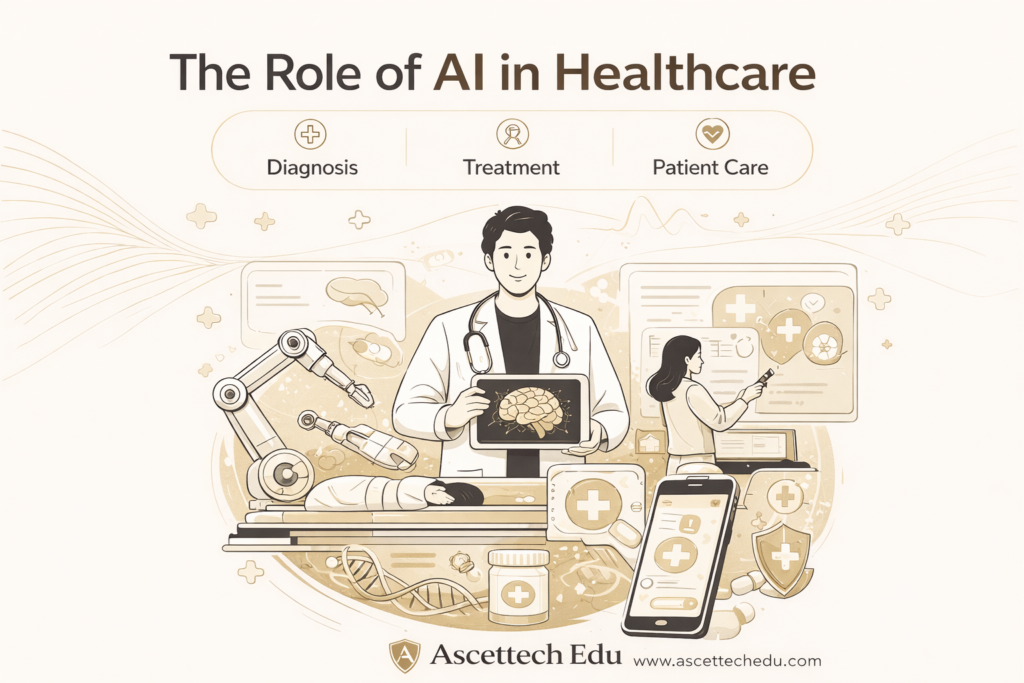
This article explores the role of AI in healthcare, focusing on three key areas: diagnosis, treatment, and patient care.
AI in Medical Diagnosis
One of the most impactful applications of AI in healthcare is medical diagnosis. Accurate and early diagnosis is crucial for effective treatment and improved patient outcomes. AI systems can analyze complex medical data such as medical images, laboratory results, and patient histories to assist doctors in identifying diseases at an early stage.
Medical Imaging and Disease Detection
AI algorithms are widely used in analyzing medical imaging such as X-rays, CT scans, and MRIs. These systems can detect patterns and abnormalities that may be difficult for the human eye to notice. For example, AI models can identify early signs of diseases such as cancer, pneumonia, or neurological disorders by examining imaging data with high precision.
In radiology, AI tools help radiologists analyze images more quickly and accurately. This reduces the time required for diagnosis and helps healthcare professionals focus more on patient care rather than spending excessive time on image analysis.
Predictive Analytics in Diagnosis
AI systems also use predictive analytics to identify the likelihood of diseases before symptoms become severe. By analyzing patient data, lifestyle habits, genetic information, and medical history, AI can predict the risk of conditions such as diabetes, heart disease, or stroke.
Predictive models allow healthcare providers to recommend preventive measures and early interventions. This proactive approach helps reduce the burden on healthcare systems and improves long-term health outcomes.
AI-Assisted Clinical Decision Support
Clinical decision support systems powered by AI assist doctors in making more informed medical decisions. These systems analyze patient records, compare them with large medical databases, and provide recommendations regarding possible diagnoses or treatment plans.
Although AI does not replace doctors, it acts as a powerful assistant that enhances medical expertise and minimizes diagnostic errors.
AI in Treatment and Medical Procedures
Beyond diagnosis, AI plays a vital role in improving treatment strategies and medical procedures. By analyzing patient data and medical research, AI helps doctors develop more personalized and effective treatment plans.
Personalized Medicine
Every patient responds differently to treatment due to variations in genetics, lifestyle, and medical history. AI enables personalized medicine by analyzing individual patient data and predicting which treatments are most likely to be effective.
For example, AI systems can analyze genetic information to determine which medications will work best for a particular patient. This approach reduces trial-and-error prescribing and minimizes potential side effects.
AI in Drug Discovery
Drug discovery is traditionally a long and expensive process that can take many years. AI accelerates this process by analyzing vast biological datasets and identifying potential drug compounds more efficiently.
Machine learning algorithms can simulate how different compounds interact with biological systems, helping researchers identify promising drug candidates quickly. This technology played a significant role in accelerating vaccine development and medical research during global health crises.
By reducing research time and cost, AI has the potential to bring life-saving drugs to market faster than traditional methods.
Robotic Surgery and Smart Medical Devices
AI-powered robotic systems are increasingly used in surgical procedures. These robots assist surgeons with greater precision, control, and minimal invasiveness. Robotic-assisted surgery allows for smaller incisions, reduced blood loss, and faster recovery times for patients.
Smart medical devices equipped with AI can also monitor patient conditions in real time. For example, wearable devices can track heart rate, physical activity, sleep patterns, and other health indicators. The data collected helps doctors monitor patient health remotely and detect potential issues before they become serious.
AI in Patient Care and Healthcare Management
AI is not only transforming diagnosis and treatment but also improving overall patient care and healthcare management. Hospitals and healthcare providers are using AI technologies to enhance efficiency, patient engagement, and healthcare accessibility.
Virtual Health Assistants and Chatbots
AI-powered chatbots and virtual assistants are becoming common in healthcare systems. These digital assistants help patients schedule appointments, receive medication reminders, and obtain basic medical information.
Virtual health assistants can also answer common health-related questions and guide patients toward appropriate medical services. This reduces the workload of healthcare staff and improves patient experience.
In telemedicine services, AI chatbots act as the first point of interaction, helping patients describe their symptoms before connecting them with a healthcare professional.
Remote Patient Monitoring
Remote patient monitoring is another important application of AI in healthcare. AI-powered devices and sensors continuously collect patient data such as blood pressure, glucose levels, and oxygen saturation.
This information is transmitted to healthcare providers who can monitor patient health in real time. Remote monitoring is especially beneficial for patients with chronic diseases such as diabetes, hypertension, or heart conditions.
It allows doctors to detect health changes early and adjust treatment plans accordingly without requiring frequent hospital visits.
Hospital Management and Workflow Optimization
Healthcare facilities often face challenges related to patient flow, resource allocation, and administrative workload. AI systems help hospitals optimize operations by analyzing data related to patient admissions, staffing requirements, and resource utilization.
For example, AI can predict patient admission rates and help hospitals allocate beds, staff, and medical equipment more efficiently. This improves hospital productivity and ensures that patients receive timely care.
AI-powered systems can also automate administrative tasks such as medical record management, billing, and documentation. This reduces paperwork and allows healthcare professionals to spend more time focusing on patient care.
Benefits of AI in Healthcare
The integration of AI into healthcare offers numerous advantages for both medical professionals and patients.
Improved Accuracy and Efficiency
AI systems can process and analyze large volumes of medical data faster than humans. This improves the accuracy of diagnosis and reduces the chances of human error.
Early Disease Detection
With the help of predictive analytics and advanced imaging analysis, AI can identify diseases at an early stage, allowing timely treatment and better patient outcomes.
Cost Reduction
AI helps reduce healthcare costs by improving operational efficiency, minimizing unnecessary tests, and speeding up drug discovery processes.
Enhanced Patient Experience
Through virtual assistants, remote monitoring, and personalized care, AI improves the overall patient experience and ensures continuous health support.
Challenges and Ethical Concerns
Despite its benefits, the use of AI in healthcare also raises certain challenges and ethical concerns.
Data Privacy and Security
Healthcare data is highly sensitive, and AI systems require access to large amounts of patient information. Ensuring data privacy and protecting medical records from cyber threats is a major concern.
Dependence on Technology
Overreliance on AI systems may lead to reduced human judgment in medical decision-making. Healthcare professionals must ensure that AI remains a supportive tool rather than a replacement for human expertise.
Implementation Costs
Implementing AI technologies requires significant investment in infrastructure, training, and system integration. Smaller healthcare institutions may find it difficult to adopt advanced AI solutions due to financial limitations.
The Future of AI in Healthcare
The future of AI in healthcare is promising. As technology continues to evolve, AI systems will become more advanced, accurate, and accessible. Innovations such as AI-driven diagnostics, predictive healthcare systems, and intelligent medical robots will further transform the healthcare industry.
AI is also expected to play a crucial role in global healthcare by improving access to medical services in remote and underserved regions. Telemedicine combined with AI-powered diagnostics can help provide quality healthcare even in areas with limited medical professionals.
In the coming years, collaboration between healthcare experts, technology companies, and policymakers will be essential to ensure responsible and effective use of AI in healthcare.
Conclusion
Artificial Intelligence is reshaping the healthcare landscape by improving diagnosis, enhancing treatment strategies, and transforming patient care. From analyzing medical images to enabling personalized medicine and remote patient monitoring, AI technologies are helping healthcare professionals deliver faster, more accurate, and more efficient medical services.
While challenges such as data privacy and implementation costs must be addressed, the benefits of AI in healthcare are undeniable. By combining human expertise with advanced AI technologies, healthcare systems can achieve better patient outcomes and more sustainable medical practices.
As AI continues to evolve, it will play an increasingly important role in shaping the future of healthcare, ultimately making medical services more accessible, efficient, and patient-centered.